

Gurama: Stories Woven from Ties transforms one of the most recognisable symbols of modern dress — the necktie — into a new artistic language.
Inspired by gurama, Azerbaijan's centuries-old patchwork tradition, the project reimagines the necktie as far more than an item of clothing. Each tie becomes a fragment of memory, identity and personal history. Every necktie once belonged to a different individual. Together they form an extraordinary archive of human stories. The donors include government ministers, ambassadors, artists, entrepreneurs, scholars, museum supporters and a former head of state of an island nation. The ties were gathered from Azerbaijan, Egypt, England, France, Hungary, Italy, Mexico, Morocco, Serbia and the United States, reflecting a remarkable geography of cultures and personal histories.

1567
ties gathered over the collection period
108
days of collecting donations
888
ties selected for the 11 compositions
10
countries represented among donors
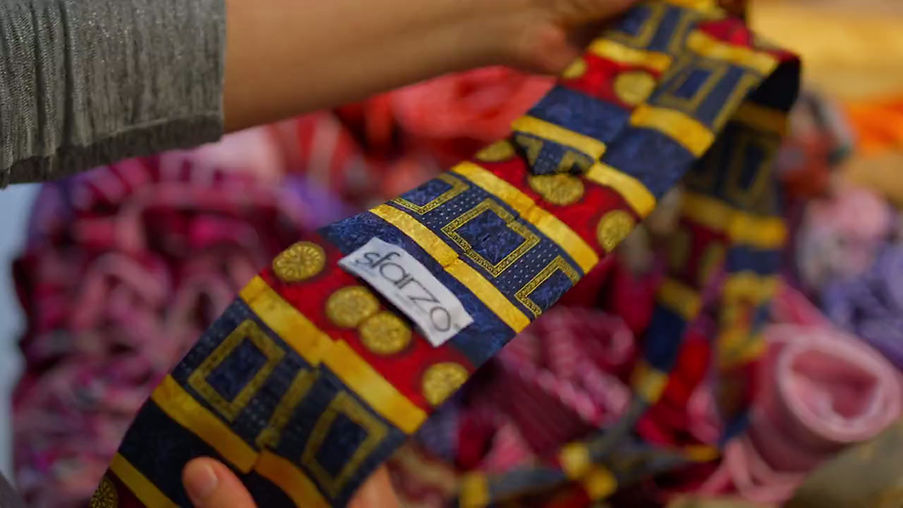
In gurama, fabric becomes memory, memory becomes heritage, and heritage becomes art.
The 11 compositions explore different themes — history, cultural identity, femininity and collective memory — yet together they form a single visual narrative about transformation.
Curated by Dr. Amina Melikova, Director of the Azerbaijan National Carpet Museum, and realised by a team of ten artists and textile makers.
GURAMA collection
Rooted in Azerbaijan's textile traditions while speaking the language of contemporary art — each work is woven entirely from donated neckties.

Shadda
2026, gurama (patchwork)
handmade, unique
h 145 x 195 cm
Inspired by the caravan scene of a traditional Shadda carpet, this work recreates its imagery through gurama, the art of patchwork. The original carpet’s figures and compositional rhythm find new expression in neckties that once belonged to different people.
The procession of camels and the vertical bands of the background create a measured sense of movement. Deep red, blue and golden tones unite the figures with a richly patterned field, while the shifting direction of the fabric lends an inner rhythm to the caravan’s steps. Each tie retains its own pattern while becoming part of the larger scene.
The ancient caravan thus begins another journey. This time, its cargo is the memory of individual lives, and its route follows the seams that connect the past with the present.

Nasimi
2026, gurama (patchwork)
handmade, unique
h 193 x 175 cm
Dedicated to Imadaddin Nasimi, this work draws on the poet’s vision of human spiritual greatness and inner freedom. His line, “Within me fit both worlds, yet I do not fit within this world,” resonates with the portrait’s central idea, evoking the boundless inner universe contained within a human form.
Fragments of different sizes shape the face and turban, lending the portrait a layered complexity. Quiet earth tones, sharply defined features and architectural forms in the background intensify the gaze. Neckties carrying traces of separate lives come together in a single face.
From the visible boundaries between the fragments, a whole and resolute presence emerges. Nasimi’s gaze seems to reach beyond the limits of the image, opening towards the two worlds held within the human spirit.

Shamakhi
2026, gurama (patchwork)
handmade, unique
h 190 x 143 cm
This work brings together Shamakhi’s landscape, vineyards and the alpacas that have found a new home here. Its vision of place embraces both the natural surroundings and the sense of shelter and belonging offered to these new inhabitants.
A red hot-air balloon rises at the centre, drawing the eye upwards against the cool tones of the sky and hills. Below, grape clusters and softly textured alpaca figures bring warmth and intimacy to the composition. The stripes of the neckties trace the slopes, while transitions of colour convey the landscape’s breadth.
This land becomes familiar even to creatures arriving from afar. Among the hills of Shamakhi, the story of a new home begins; beneath the ascending balloon lies the quiet joy of finding a place to belong.

Beauty of the Caspian
(dedicated to Sattar Bahlulzade)
2026, gurama (patchwork)
handmade, unique
h 193 x 149 cm
Dedicated to Sattar Bahlulzade, this work interprets the Caspian’s industrial landscape through the expressive possibilities of gurama. The sea and oil derricks become the defining images of a place shaped jointly by nature and human labour.
The black silhouettes of the derricks form an intricate network of lines against a luminous sky. Grey, white and silvery fabrics distribute light across the surface, while blue tones below suggest the movement of waves. The stripes of the neckties emphasise the structures’ rigid geometry; the softness of the fabric balances their weight.
Between the flow of water and the stillness of metal, a contemplative landscape unfolds. Here, the Caspian holds both the breath of nature and the human lives inscribed upon its shores and waters.

Gurama
2026, gurama (patchwork)
handmade, unique
d 190 cm
Created using the classical, traditional technique of gurama, this composition brings together pieces of fabric in different colours and patterns to form a unified surface. A circular format and successive rows radiating from the centre give visual expression to this principle.
A small, flower-like centre expands through petal-shaped arrangements to encompass the entire surface. Alternating warm and cool tones, together with changes in the scale and direction of the fragments, draw the eye inwards and then out towards the edges. Within these recurring forms, each piece preserves its own pattern and individuality.
In this circle of colour, every fragment has its place and every connection its own harmony. As the pieces come together, the surface seems to breathe, and wholeness emerges from differences living side by side.

Dogs and Horses
2026, gurama (patchwork)
handmade, unique
h 145 x 95 cm
This composition takes inspiration from the imagery of Atli-itli carpets associated with the Shusha group of the Karabakh carpet-weaving school. Their traditional animal figures are reinterpreted through gurama, taking shape in fabrics of varied patterns.
Arranged vertically within a dark blue central field, the dog and horse stand out through their clearly defined contours. Colourful fragments animate their forms, while plant motifs and small geometric elements fill the surrounding space. Layered borders and diagonal bands enclose the quiet centre within a lively frame.
Familiar figures from the past continue their lives in new fabrics. The companionable presence of the dog and the composed stance of the horse recall the unspoken bond between humans and animals, sustained across generations.

The Figs in Danger
2026, gurama (patchwork)
handmade, unique
h 193 x 151 cm
The scene centres on a tree laden with ripe figs and a black bird perched upon its branch. The sense of danger introduced by the title draws attention to the relationship between nature’s abundance and its uncertain fate.
Golden fruit glows among dense green leaves, while the bird’s dark silhouette creates a point of focus. Leaf veins, rounded fruit and twisting branches are rendered in raised textures, giving the image a tactile vitality. The distant landscape opens a wider space around this small event unfolding in the foreground.
The garden is still quiet, yet within that stillness the first moment of action is anticipated. As the ripe fruit gleams on the branch, the beauty of abundance and its fragility draw ever closer.

Icon
2026, gurama (patchwork)
handmade, unique
h 213 x 136 cm
Created to mark the centenary of Marilyn Monroe’s birth, this work reimagines her enduring image in popular culture through gurama. Neckties that once belonged to different people come together to depict one of the world’s most recognisable women.
Pale fabrics shape the light across her face, while red lips and expressive eyes become the portrait’s principal accents. Sculptural fabric flowers surround her features, bringing both splendour and tenderness to the composition. Viewed closely, the face opens into separate patterns; from a distance, it resolves into a familiar whole.
Here, the celebrated smile emerges from countless personal stories. Every seam makes room within this luminous image for human vulnerability and the desire to live on in memory.

People
2026, mixed technique,
carpet, tapestry, applique
handmade, unique
h 215 x 132 cm
This work portrays prominent figures in contemporary carpet art and friends of the art form. Together, the portraits evoke the shared cultural world of those who create, sustain and gather around this living tradition.
Combining carpet, tapestry and appliqué, the composition gives each figure a distinct character through individual features, expressions, colourful scarves and neckties. Surrounding ornaments unite the portraits within a single field, reinforced by the rhythm of red and blue tones. The texture of the materials brings the warmth of handwork to each face.
Here, the memory of an art form becomes visible in the people who keep it alive. Each gaze carries the trace of a life; together, the portraits tell a story of friendship, creativity and a tradition continued through shared devotion.

Venice
2026, gurama (patchwork)
handmade, unique
h 190 x 149 cm
This work brings Venice’s canals, bridge, waterfront architecture and gondolas together through the expressive language of textiles. The city’s daily life upon the water forms the central theme of the composition.
Undulating arrangements of blue animate the surface. The warm colours of the buildings balance the coolness of the water, while architectural verticals and the curve of the bridge guide the eye through the scene. In the foreground, the gondolier lends a human rhythm to the expansive cityscape. Dense textile textures convey both the weight of stone and the tremor of water within a single surface.
Separate shores are joined by bridges, separate fabrics by seams. As water flows between them, the city seems to reassemble itself in memory, each wave carrying a recollection of this quiet journey.

She
2026, gurama (patchwork)
handmade, unique
h 210 x 192 cm
The work centres on the transformation of the necktie, traditionally associated with masculine dress, into the artistic material of a female image. Fabrics belonging to different people come together around a woman’s silhouette, expressing the relationship between individual histories and identity.
Neckties radiating from the centre merge dress and background into a continuous field of movement. Their changing stripes and rhythmic colours accentuate the figure’s stillness. The absence of facial features leaves the image open to the viewer’s own memories: a familiar posture or a cherished presence may be recognised within the silhouette.
Every piece surrounding her carries the trace of another life. Amid these many stories, the woman retains her quiet presence—a self shaped by connection, yet remaining distinctly her own.

Organiser
This project is organised by the
Azerbaijan National Carpet Museum
Curator
Dr. Amina Melikova
-
Director, Azerbaijan National Carpet Museum
-
Co-curator, Azerbaijan Pavilion, Venice Biennale
-
PhD in Art History
-
Honoured Cultural Worker of Azerbaijan, 2017
-
Humay National Prize, 2020
-
30 years of museum leadership
-
Author of five books on Azerbaijani art and heritage
With over three decades of experience in museum leadership and cultural diplomacy, Dr. Melikova has held senior positions at the Azerbaijan National Museum of Art, the Museum Centre, the Icherisheher Museum Centre and the Heydar Aliyev Centre.
She is the author of Oil and Art, The Art of Kelaghayi, Shirvanshahs' Heritage in World Museums, Art of GURAMA (Patchwork) and several other books and publications dedicated to the art and cultural heritage of Azerbaijan.
Rather than preserving fabric alone, the exhibitions she curates preserve memory — demonstrating how ordinary objects can become witnesses to their time and carriers of intangible cultural heritage.